Abstract base class for material models. More...
#include "Material.h"
Public Member Functions | |
| Material (const String &name, const Properties &conf, const Properties &props, const Properties &globdat) | |
| Constructs a new Material object. | |
| virtual void | configure (const Properties &props, const Properties &globdat) |
| Configure the material with given properties. | |
| virtual void | getConfig (const Properties &conf, const Properties &globdat) const |
| Retrieve current material configuration. | |
| virtual void | getStress (const Vector &stress, const Vector &strain)=0 |
| Compute stress vector from strain vector. | |
| virtual void | getStress (const Vector &stress, const Vector &strain, const idx_t &ielem, const idx_t &ip, const bool inelastic=true) |
| Compute stress with element and integration point context. | |
| virtual Matrix | getMaterialStiff () const =0 |
| Get the material stiffness matrix. | |
| virtual Matrix | getMaterialStiff (const idx_t &ielem, const idx_t &ip) const |
| Get the material stiffness matrix for specific element and integration point. | |
| virtual Matrix | getMaterialMass () const =0 |
| Get the material mass matrix per unit length. | |
| virtual Matrix | getMaterialMass (const idx_t &ielem, const idx_t &ip) const |
| Get the material mass matrix for specific element and integration point. | |
| virtual Matrix | getLumpedMass (const double l) const |
| Get the lumped mass matrix for a given element length. | |
| virtual Matrix | getLumpedMass (const double l, const idx_t &ielem) const |
| Get the lumped mass matrix for specific element and length. | |
| virtual void | applyDeform ()=0 |
| Apply computed deformation to the material state. | |
| virtual void | rejectDeform ()=0 |
| Reject the current deformation and revert to previous state. | |
| virtual void | getTable (const String &name, XTable &strain_table, const IdxVector &items, const Vector &weights) const =0 |
| Populate strain table with material-specific data. | |
| virtual double | getDissipatedEnergy (const idx_t &ielem, const idx_t &ip) const =0 |
| Get the dissipated energy at a specific integration point. | |
| virtual double | getPotentialEnergy (const idx_t &ielem, const idx_t &ip) const =0 |
| Get the potential energy at a specific integration point. | |
| virtual double | getHardeningPotential (const idx_t &ielem, const idx_t &ip) const =0 |
| Get the hardening potential energy at a specific integration point. | |
| virtual String | getContext () const override |
| Get the context string for error reporting and debugging. | |
Static Public Attributes | |
| static const char * | VERBOSITY_PROP = "verbosity" |
| Property name for verbosity level control. | |
Protected Member Functions | |
| virtual | ~Material () |
| Destroy the Material object. | |
Protected Attributes | |
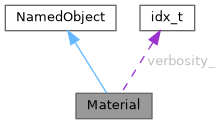
| idx_t | verbosity_ |
| Verbosity level for material output and debugging. | |
Detailed Description
Defines interface for material behavior including stress-strain relationships, stiffness matrices, and energy calculations. Materials are created via MaterialFactory and support multiple integration points per element.
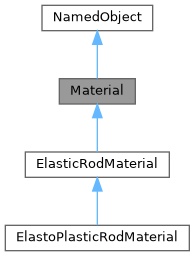
Hierarchy
- ElasticRodMaterial: Linear elastic material
- ElastoPlasticRodMaterial: Elasto-plastic with hardening
Constructor & Destructor Documentation
◆ Material()
| Material::Material | ( | const String & | name, |
| const Properties & | conf, | ||
| const Properties & | props, | ||
| const Properties & | globdat | ||
| ) |
- Parameters
-
name Material instance name for identification conf Configuration properties container for output props Input properties for material parameters globdat Global data container for simulation state
◆ ~Material()
|
protectedvirtual |
Virtual destructor ensures proper cleanup of derived classes. Each material type can clean up its specific resources.
Member Function Documentation
◆ applyDeform()
|
pure virtual |
This method commits the current deformation state to the material's internal variables. It's typically called at the end of a successful load step to update the material's permanent state.
Implemented in ElasticRodMaterial, and ElastoPlasticRodMaterial.
◆ configure()
|
virtual |
- Parameters
-
props Properties containing configuration parameters globdat Global data container with simulation context
- Exceptions
-
Derived classes may throw exceptions for invalid parameters
Reimplemented in ElasticRodMaterial, and ElastoPlasticRodMaterial.
◆ getConfig()
|
virtual |
- Parameters
-
conf Properties object to store configuration in globdat Global data container with simulation context
Reimplemented in ElasticRodMaterial, and ElastoPlasticRodMaterial.
◆ getContext()
|
overridevirtual |
- Returns
- Context string identifying this material instance
- Note
- 0 for purely elastic materials
◆ getDissipatedEnergy()
|
pure virtual |
Computes the energy dissipated through inelastic processes at the specified element and integration point location.
- Parameters
-
ielem Element index ip Integration point index within the element
- Returns
- Total dissipated energy at the specified location
Implemented in ElasticRodMaterial, and ElastoPlasticRodMaterial.
◆ getHardeningPotential()
|
pure virtual |
Computes the energy stored in hardening variables for plasticity models. This represents the energy associated with the evolution of the yield surface.
- Parameters
-
ielem Element index ip Integration point index within the element
- Returns
- Hardening potential energy at the specified location
Implemented in ElasticRodMaterial, and ElastoPlasticRodMaterial.
◆ getLumpedMass() [1/2]
|
virtual |
Computes a lumped (diagonal) mass matrix for the given element length.
- Parameters
-
l Element length
- Returns
- Lumped mass matrix for the element
Reimplemented in ElasticRodMaterial.
◆ getLumpedMass() [2/2]
|
inlinevirtual |
Default element-specific lumped mass.
Element-specific version of lumped mass computation.
- Parameters
-
l Element length ielem Element index for potential customization
- Returns
- Lumped mass matrix for the specified element
Reimplemented in ElasticRodMaterial.
◆ getMaterialMass() [1/2]
|
pure virtual |
Computes the material mass density matrix used in dynamic analysis. The translational part of the mass matrix is typically diagonal with density values.
- Returns
- Mass matrix per unit length
Implemented in ElasticRodMaterial.
◆ getMaterialMass() [2/2]
|
inlinevirtual |
Default element-specific mass matrix.
Enhanced version for element-specific mass computation.
- Parameters
-
ielem Element index for potential state tracking ip Integration point index within the element
- Returns
- Material mass matrix for the specified location
Reimplemented in ElasticRodMaterial.
◆ getMaterialStiff() [1/2]
|
pure virtual |
Computes the material stiffness matrix relating stress to strain. This matrix represents the tangent modulus of the material at the current state.
- Returns
- Material stiffness matrix
Implemented in ElasticRodMaterial.
◆ getMaterialStiff() [2/2]
|
inlinevirtual |
Default element-specific stiffness matrix.
Enhanced version that allows state-dependent stiffness computation.
- Parameters
-
ielem Element index for state tracking ip Integration point index within the element
- Returns
- Material stiffness matrix for the specified location
- Note
- Default implementation delegates to getMaterialStiff()
Reimplemented in ElasticRodMaterial.
◆ getPotentialEnergy()
|
pure virtual |
Computes the stored elastic energy at the specified element and integration point location.
- Parameters
-
ielem Element index ip Integration point index within the element
- Returns
- Elastic potential energy at the specified location
- Note
- 0 for purely elastic materials
Implemented in ElasticRodMaterial, and ElastoPlasticRodMaterial.
◆ getStress() [1/2]
|
pure virtual |
Fundamental constitutive relationship defining material response to deformation. All derived material classes must implement this method.
- Parameters
-
[out] stress Computed stress vector at current state [in] strain Input strain vector for stress computation
- Note
- For rod elements: 6-dimensional vectors (axial, shear, bending, torsion)
Implemented in ElasticRodMaterial, and ElastoPlasticRodMaterial.
◆ getStress() [2/2]
|
inlinevirtual |
Default element-specific stress computation.
- Parameters
-
[out] stress Computed stress vector [in] strain Input strain vector [in] ielem Element index for state tracking [in] ip Integration point index [in] inelastic Enable inelastic behavior (default: true)
- Note
- Default delegates to getStress(stress, strain) ElastoPlasticRodMaterial overrides for plastic state management
Reimplemented in ElasticRodMaterial, and ElastoPlasticRodMaterial.
◆ getTable()
|
pure virtual |
This method fills an XTable with strain-related data for output or post-processing purposes. The specific data depends on the material type.
- Parameters
-
name Name identifier for the table data strain_table Output table to populate with strain data items Index vector specifying which items to include weights Weight vector for data averaging or integration
Implemented in ElasticRodMaterial, and ElastoPlasticRodMaterial.
◆ rejectDeform()
|
pure virtual |
This method reverts the material to its state before the current load step. It's called when a load step fails to converge or needs to be repeated.
Implemented in ElasticRodMaterial, and ElastoPlasticRodMaterial.
Member Data Documentation
◆ verbosity_
|
protected |
◆ VERBOSITY_PROP
|
static |